HOT PRODUCTS
Cnc turned parts | What are CNC turning products?
What are CNC turning products?
Table of Contents
- 1. Introduction to CNC Turning & CNC Turned Parts
- 2. What Are CNC Turned Parts? (Core Definition & Features)
- 2.1 Visual of CNC Turned Parts
- 3. Common Types of CNC Turned Parts
- 4. Advantages & Disadvantages of CNC Turning (Focus on Benefits)
- 5. Expert Opinions on CNC Turned Parts
- 6. FAQs About CNC Turning & CNC Turned Parts
- 7. Conclusion
1. Introduction to CNC Turning & CNC Turned Parts
In the era of precision manufacturing, CNC turning has become a cornerstone technology, powering the production of high-quality, consistent components across countless industries. Unlike traditional manual turning, CNC (Computer Numerical Control) turning uses computer-programmed instructions (G-code) to control lathe operations, ensuring unparalleled accuracy and efficiency[3]. At the heart of this process are CNC turned parts—precision-machined components that serve as critical building blocks for machinery, electronics, aerospace equipment, and more. This blog will delve into what CNC turned parts are, their key features, applications, and why they are indispensable in modern manufacturing, while also comparing the pros and cons of CNC turning to highlight its unique advantages.
2. What Are CNC Turned Parts? (Core Definition & Features)
CNC turned parts are cylindrical or rotationally symmetric components manufactured through the CNC turning process. The process involves securing a raw material (such as metal, plastic, or alloy) in a lathe, which rotates the material at high speeds while stationary cutting tools remove excess material to achieve the desired shape, size, and finish[2]. Unlike manual turning, CNC turning eliminates human error, ensuring each part is identical to the next—even in large production batches[4]. This makes CNC turned parts the preferred choice for industries where precision and consistency are non-negotiable.
Key features of high-quality CNC turned parts include:
- Tight dimensional tolerances: Typically ranging from ±0.0005 inches (0.0127 mm) to ±0.005 inches (0.127 mm), far exceeding the precision of manual turning[4][5]. In high-precision applications like aerospace components, tolerances can even reach tighter levels, ensuring seamless integration with other parts[2]. This level of precision is critical for components used in aerospace engines, medical implants, and semiconductor equipment, where even the smallest deviation can lead to catastrophic failure[1].
- Smooth surface finishes: Achieving Ra values as low as 0.8 μm, reducing the need for secondary polishing or finishing[2]. This smooth finish not only enhances the aesthetic appeal of the parts but also reduces friction and wear, extending their service life in mechanical applications[3]. For medical components and precision machinery, this finish also ensures biocompatibility and optimal performance[6].
- Consistency & repeatability: Once programmed, CNC lathes produce identical parts indefinitely, critical for mass production[4]. This consistency eliminates the variability associated with manual turning, ensuring that every component meets the same strict standards, which is essential for industries like automotive and medical device manufacturing[5]. A medical implant client, for example, reduced dimensional variances by 90% after switching from manual to CNC turning[8].
- Versatile geometries: Capable of producing complex features like threads, tapers, grooves, and undercuts in a single setup[4]. Advanced CNC turning machines with live tooling can even handle more intricate designs, reducing the need for multiple machining operations and saving time and costs[6]. This versatility allows for the production of components with complex contours and features that would be difficult or impossible to achieve with manual turning[7].
2.1 Visual of CNC Turned Parts
Below is a clear image showing various high-precision CNC turned parts, including threaded connectors, cylindrical shafts, and precision bushings—common examples of components produced through CNC turning:
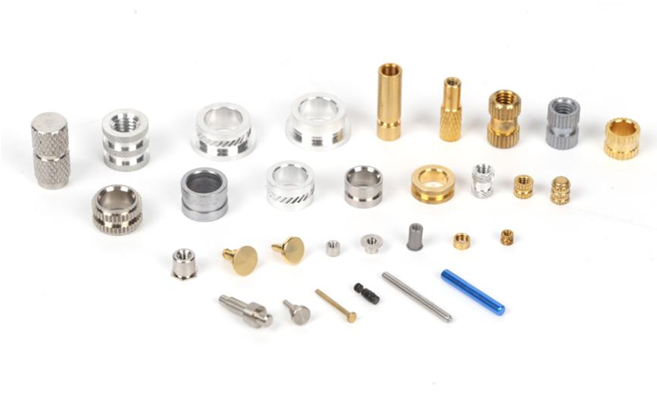
A collection of precision CNC turned parts, including shafts, bushings, and threaded components, showcasing smooth finishes and tight tolerances
3. Common Types of CNC Turned Parts
CNC turned parts come in a wide range of types, tailored to meet the diverse needs of different industries. Their design and specifications vary based on application, material, and performance requirements. Here are the most common types:
3.1 Shafts & Spindles
These are cylindrical components used to transmit torque and support rotating parts in machinery. CNC turned shafts and spindles are widely used in automotive engines, industrial machinery, and aerospace equipment, where precision and durability are key[9]. They often feature tight tolerances and smooth surface finishes to ensure seamless rotation and minimal wear.
3.2 Bushings & Bearings
Bushings (also called sleeves) and bearings reduce friction between moving parts, extending the service life of machinery. CNC turned bushings are made from materials like brass, steel, or plastic, and their precise dimensions ensure a perfect fit with other components[1]. They are commonly used in hydraulic systems, automotive suspension, and electronic devices.
3.3 Threaded Components
Including bolts, nuts, screws, and threaded connectors, these parts are essential for assembling and securing components. CNC turning ensures consistent thread pitch and depth, making them reliable for high-stress applications in construction, automotive, and aerospace industries[6]. Threaded CNC turned parts often require tight tolerances to ensure proper mating with other threaded components.
3.4 Pins & Studs
Small, cylindrical CNC turned parts used for alignment, fastening, or joining components. Pins and studs are widely used in electronics, medical devices, and consumer goods, where their small size and precision are critical[5]. They can be customized with grooves, tapers, or other features to meet specific application needs.
3.5 Custom Precision Components
For specialized industries like aerospace, medical, and defense, custom CNC turned parts are designed to meet unique requirements. These include complex geometries, exotic materials (such as titanium or Inconel), and ultra-tight tolerances[8]. Examples include medical implants, aerospace turbine components, and defense equipment parts[1].
4. Advantages & Disadvantages of CNC Turning (Focus on Benefits)
While CNC turning has become the gold standard for precision manufacturing, it’s important to understand its pros and cons—with a focus on how its advantages far outweigh any limitations, especially when it comes to producing high-qualityCNC turned parts.
4.1 Key Advantages of CNC Turning (Focus on Benefits)
- Unmatched Precision & Consistency: As mentioned earlier, CNC turning eliminates human error, delivering CNC turned parts with tight tolerances and consistent quality across batches[3]. This is a game-changer for industries like medical and aerospace, where even minor deviations can lead to product failure or safety risks[1]. In high-volume aerospace projects, CNC turning consistently delivers tolerances within ±0.0005 inches—impossible with manual lathes[8].
- High Efficiency & Productivity: CNC lathes can operate 24/7 with minimal human intervention, significantly increasing production output compared to manual turning[7]. Once programmed, they can produce parts faster, reducing lead times and labor costs. For example, an automotive client needed 10,000 bushings in 3 weeks; CNC turning reduced cycle time from 8 minutes (manual) to 2.5 minutes and cut labor costs by 60%[8].
- Versatility in Material & Design: CNC turning can handle a wide range of materials, including metals (aluminum, steel, titanium), plastics, and alloys[6]. It also supports complex geometries, allowing for the production of CNC turned parts with threads, tapers, and undercuts in a single setup—eliminating the need for multiple machining steps and reducing production costs[4]. Advanced CNC turning centers with live tooling can even machine non-round features like flats or hex shapes[5].
- Reduced Waste & Cost Savings: The precision of CNC turning minimizes material waste, as it removes only the necessary excess material[8]. Additionally, the consistency of CNC turned parts reduces the need for rework or scrap, further cutting costs. For high-volume production, the cost per part decreases significantly, making CNC turning a cost-effective solution[7].
- Easy Automation & Scalability: CNC turning can be integrated with automation systems (such as robotic loaders) to further reduce labor costs and increase production capacity[7]. It also scales easily—whether you need 10 prototype parts or 100,000 mass-produced components, CNC turning can adapt to your needs without sacrificing quality[9].
4.2 Disadvantages of CNC Turning (and How to Mitigate Them)
- High Initial Investment: CNC lathes and programming software require a higher upfront cost compared to manual lathes[8]. However, this investment is offset by long-term savings in labor, waste, and rework—especially for high-volume production. Small businesses can mitigate this by leasing equipment, using used machines, or subcontracting CNC work[8].
- Need for Skilled Programmers: CNC turning requires trained programmers to create and optimize G-code programs[7]. This can be a barrier for small operations, but training programs and user-friendly software have made programming more accessible. Many manufacturers also offer programming support to help clients get started[5].
- Setup Time for Small Batches: For small production batches (fewer than 100 parts), the setup time for CNC turning can be longer than manual turning[8]. This can be mitigated by using modular fixtures and pre-programmed templates, which reduce setup time by 50% or more[8].
- Material Limitations: CNC turning can struggle with extremely soft materials (e.g., pure copper) or composites, which may deform or cause excessive tool wear[8]. Solutions include using high-speed carbide tools for soft materials and PCD (polycrystalline diamond) tools for composites, which extend tool life by 300%[8].
5. Expert Opinions on CNC Turned Parts
To gain deeper insights into the value of CNC turned parts and CNC turning technology, we’ve gathered opinions from industry experts with decades of experience in precision manufacturing.
5.1 Expert 1: Sarah Miller, Senior Manufacturing Engineer at AeroPrecision (Aerospace Industry)
“In the aerospace industry,CNC turned parts are non-negotiable—our components need to meet ultra-tight tolerances to ensure safety and performance. CNC turning has revolutionized our production process: we used to spend hours reworking manual parts, but now we get consistent, high-quality components every time. The ability to produce complex geometries in a single setup has cut our lead times by 40%, and the precision of CNC turned parts has reduced our failure rate to near zero. For aerospace applications, where even a 0.001-inch deviation can be catastrophic, CNC turning is the only viable solution[8].”
5.2 Expert 2: Michael Chen, CEO of PrecisionTurn (Custom CNC Manufacturing)
“Our clients across automotive, medical, and electronics industries all demand CNC turned parts because of their consistency and reliability. What sets CNC turning apart is its ability to scale—we can produce 10 prototype parts for a startup and then ramp up to 100,000 parts for a large manufacturer, all with the same precision. The key advantage of CNC turned parts is that they eliminate human error, which is critical for industries like medical, where a faulty part can put lives at risk. We’ve seen clients reduce their production costs by 30% just by switching to CNC turned parts, thanks to less waste and rework[4].”
5.3 Expert 3: Lisa Wong, Materials Science Specialist at TechMetals (Metals & Alloys)
“CNC turning unlocks the full potential of advanced materials—from titanium to high-strength alloys. CNC turned parts made from these materials offer superior durability and performance, which is essential for harsh environments like oil and gas or aerospace. The precision of CNC turning ensures that we can machine these hard-to-work materials without compromising their structural integrity. For example, we recently produced CNC turned valve bodies for the oil and gas industry that can withstand extreme pressures and temperatures, something that would be impossible with manual turning[1][6].”
6. FAQs About CNC Turning & CNC Turned Parts
Below are answers to the most common questions about CNC turning and CNC turned parts, based on industry trends and expert insights.
Q1: What is the difference between CNC turned parts and CNC milled parts?
A: The key difference lies in the machining process. CNC turned parts are produced by rotating the raw material (workpiece) while a stationary cutting tool removes excess material—ideal for cylindrical or rotationally symmetric parts[2]. CNC milled parts are produced by rotating the cutting tool while the workpiece remains stationary—better for flat, irregular, or non-cylindrical shapes[4]. CNC turned parts are more efficient for rotational components, while milled parts are better for complex, non-rotational designs.
Q2: What materials are commonly used for CNC turned parts?
A: CNC turned parts can be made from a wide range of materials, including: metals (aluminum, steel, stainless steel, titanium, brass), plastics (ABS, PVC, PEEK), and alloys (Inconel, brass alloys)[6]. The choice of material depends on the application—for example, titanium is used for aerospace and medical parts (due to its strength and biocompatibility), while aluminum is used for automotive and electronic parts (due to its light weight)[1][9].
Q3: How tight are the tolerances for CNC turned parts?
A: Typical tolerances forCNC turned parts range from ±0.0005 inches (0.0127 mm) to ±0.005 inches (0.127 mm)[4][5]. For high-precision applications (e.g., aerospace, medical), tolerances can be as tight as ±0.0001 inches (0.00254 mm)[8]. This level of precision is far superior to manual turning, which typically has tolerances of ±0.01 inches or more[3].
Q4: Can CNC turned parts be customized for specific applications?
A: Yes! One of the biggest advantages of CNC turning is its flexibility—CNC turned parts can be fully customized to meet unique design requirements[9]. This includes custom geometries (threads, tapers, undercuts), material choices, surface finishes, and tolerances. Manufacturers can work with clients to create custom parts for specialized industries like aerospace, medical, and defense[1][4].
Q5: Is CNC turning more cost-effective than manual turning?
A: For most production runs—especially high-volume or high-precision—yes, CNC turning is more cost-effective[8]. While the initial investment is higher, CNC turning reduces labor costs, waste, and rework, leading to lower overall costs per part. For small batches (fewer than 100 parts), manual turning may be cheaper due to shorter setup times, but modular fixtures and pre-programmed templates have made CNC turning more cost-effective even for small runs[8].
Q6: What is “live tooling” and how does it benefit CNC turned parts?
A: Live tooling refers to powered, rotating cutting tools held in the CNC lathe’s turret[5]. This allows the lathe to perform secondary operations (such as drilling, milling, or tapping) in the same setup, eliminating the need for multiple machining steps[7]. Live tooling reduces production time, improves precision (by avoiding repositioning the workpiece), and enables the production of more complex CNC turned parts with non-rotational features[5][8].
Q7: How long does it take to produce CNC turned parts?
A: Production time depends on the complexity of the part, material, and batch size[6]. Simple CNC turned parts (e.g., a basic bushing) can be produced in a few minutes per part, while complex parts (e.g., aerospace turbine shafts) may take 30 minutes or more per part. Setup time for CNC turning typically ranges from 30 minutes to 2 hours, but this is a one-time cost for a production run[8]. For high-volume batches, the setup time is negligible compared to the total production time.
7. Conclusion
CNC turned parts are the backbone of modern precision manufacturing, offering unmatched precision, consistency, and versatility across countless industries. From aerospace and medical to automotive and electronics, these components play a critical role in ensuring the performance and reliability of machinery and devices. CNC turning, with its numerous advantages—including high efficiency, reduced waste, and scalability—far outweighs its minor limitations, making it the preferred method for producing high-quality CNC turned parts.
As industry experts note, the precision and consistency of CNC turned parts have revolutionized production processes, reducing costs, improving safety, and enabling innovation in specialized fields. Whether you need a small batch of custom parts or large-scale mass production, CNC turned parts deliver the quality and reliability that modern industries demand.
In summary, CNC turning is more than just a machining process—it’s a solution that empowers manufacturers to create better, more efficient products, and CNC turned parts are the tangible result of this advanced technology, driving progress in precision manufacturing worldwide.
CNC manufacturing process | What are the CNC production processes? A Comprehensive Guide
Surveillance camera | What is a CNC electronics enclosure? Focus on Surveillance Camera Applications
Related Article