HOT PRODUCTS
What is cnc in machining? A Complete Guide to CNC Machining
2026-03-26
What is CNC in Machining? A Complete Guide to CNC Machining
Table of Contents
- 1. Introduction: What is CNC in Machining?
- 2. Core Definition of CNC in Machining
- 3. Standard Technical Parameters Table for CNC in Machining
- 4. Key Focuses & Critical Points of CNC in Machining
- 5. Top Benefits of CNC in Machining
- 6. Expert Insight on CNC in Machining
- 7. Frequently Asked Questions (FAQs) About CNC in Machining
- Conclusion
1. Introduction: What is CNC in Machining?
In the modern manufacturing industry, CNC in machining has become a cornerstone technology, revolutionizing how metal and non-metal parts are produced. If you’ve ever wondered what is CNC in machining, you’re not alone—this guide breaks down the essentials of CNC in machining, from its core definition to its key benefits, ensuring you gain a clear understanding of this critical manufacturing process.
CNC in machining (Computer Numerical Control Machining) replaces manual operation with computerized precision, enabling consistent, high-quality production of complex parts. Unlike traditional manual machining, CNC in machining uses pre-programmed software to control machine tools, eliminating human error and boosting efficiency. Whether you’re in automotive, aerospace, electronics, or industrial equipment, understanding CNC in machining is essential for staying competitive in today’s manufacturing landscape.
2. Core Definition of CNC in Machining
To answer what is CNC in machining clearly, we start with its basic definition and key components:
2.1 What Does CNC in Machining Mean?
CNC in machining refers to a manufacturing process where computerized systems (CNC controllers) execute pre-programmed commands to operate machine tools (e.g., mills, lathes, routers) and shape raw materials (metal, plastic, wood) into finished parts with high precision.
The term “CNC” stands for Computer Numerical Control—meaning the machine’s movements (cutting, drilling, milling) are controlled by numerical codes (G-codes, M-codes) embedded in a software program. This automation is what sets CNC in machining apart from manual machining, making it faster, more accurate, and more consistent.
2.2 Key Components of CNC in Machining
A typical CNC in machining system consists of three core components, all working together to ensure precise production:
-
CNC Controller: The “brain” of the system, which reads and executes the pre-programmed code, controlling the machine’s movements and operations.
-
Machine Tool: The physical equipment that shapes the raw material (e.g., CNC mill, CNC lathe, CNC router). The type of tool depends on the part’s design and material.
-
CAD/CAM Software: Computer-Aided Design (CAD) software is used to create the part’s digital model; Computer-Aided Manufacturing (CAM) software converts this model into the numerical code (G-code) that the CNC controller uses.
2.3 Common Types of CNC Machining Processes
CNC in machining includes several specialized processes, each designed for specific part shapes and materials:
-
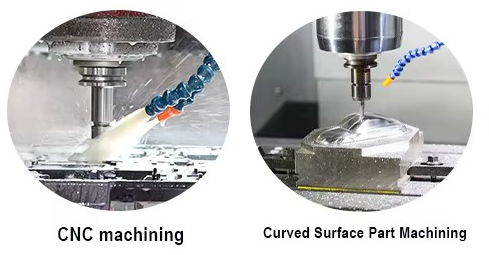
CNC Milling: Uses rotating cutting tools to remove material from the workpiece, ideal for flat surfaces, slots, and complex 3D shapes.
-
CNC Turning: Rotates the workpiece while a cutting tool shapes it, perfect for cylindrical parts (e.g., shafts, bolts).
-
CNC Drilling: Automates hole drilling with precise depth and positioning, used in almost all manufacturing industries.
-
CNC Grinding: Uses abrasive wheels to achieve ultra-smooth surfaces and tight tolerances, common in high-precision applications.
3. Standard Technical Parameters Table for CNC in Machining
The following table lists general industrial parameters for conventional CNC in machining, widely adopted across manufacturing sectors. These parameters vary slightly based on the machine type and material, but serve as a reliable reference:
| Parameter Item | Typical Range | Unit | Notes |
|---|---|---|---|
| Spindle Speed | 1,000 – 15,000 | RPM | Higher for non-ferrous metals (aluminum), lower for steel |
| Feed Rate | 50 – 5,000 | mm/min | Depends on material hardness and tool type |
| Dimensional Tolerance | ±0.005 – ±0.10 | mm | Tighter tolerances for high-precision parts |
| Spindle Power | 3 – 30 | kW | Larger machines require higher power |
| Travel Range (X/Y/Z Axes) | 500 – 2,000 / 300 – 1,500 / 300 – 1,000 | mm | Varies by machine size (small to large format) |
| Tool Change Time | 0.5 – 5 | Seconds | Faster for automated CNC machines |
| Common Materials | Aluminum, Steel, Copper, Plastic, Wood | — | Adaptable to most solid materials |
4. Key Focuses & Critical Points of CNC in Machining
To achieve optimal results with CNC in machining, it’s critical to focus on the following key areas—these factors directly impact part quality, efficiency, and machine longevity:
4.1 Programming Accuracy
The pre-programmed G-code is the foundation of CNC in machining. Even minor errors in the code (e.g., incorrect coordinates, feed rate) can lead to defective parts or machine damage. Always verify the code with CAD/CAM software and run a test (dry run) before full production.
4.2 Tool Selection & Maintenance
Choosing the right cutting tool for the material and process is essential. For example, carbide tools are ideal for hard metals (steel), while HSS tools work well for softer materials (aluminum). Regular tool maintenance (sharpening, replacement) prevents tool wear, which causes poor surface finish and dimensional errors.
4.3 Material Preparation
Raw materials must be properly prepared (cut to size, cleaned, deburred) before loading into the CNC machine. Improperly prepared materials can cause misalignment, tool damage, or uneven cutting.
4.4 Machine Calibration
Regular calibration of the CNC machine ensures it maintains precise movements and tolerances. Calibrate axes, spindle speed, and feed rate periodically to avoid drift (small deviations over time) that affects part quality.
4.5 Quality Control During Machining
While CNC in machining is automated, regular quality checks (mid-production) are critical. Use measuring tools (calipers, 3D scanners) to verify dimensions and surface finish, ensuring the process stays on track.
5. Top Benefits of CNC in Machining
CNC in machining offers numerous advantages over traditional manual machining, making it the preferred choice for modern manufacturing. Below are its core benefits:
5.1 High Precision & Consistency
CNC in machining eliminates human error, ensuring every part is identical and meets tight dimensional tolerances. This consistency is critical for mass production, where interchangeability of parts is essential.
5.2 Increased Production Efficiency
CNC machines operate 24/7 (with minimal human supervision), reducing production time and increasing throughput. They also have faster cycle times than manual machines, especially for complex parts that would require multiple manual operations.
5.3 Ability to Produce Complex Parts
CNC in machining can create intricate, complex shapes (3D contours, internal cavities, fine details) that are impossible or difficult to achieve with manual machining. This flexibility makes it ideal for custom parts and advanced manufacturing applications.
5.4 Cost Savings in Long-Term Production
While initial investment in CNC machines is higher, CNC in machining reduces long-term costs by minimizing waste (fewer defective parts), reducing labor costs (less manual operation), and extending tool life (controlled cutting parameters).
5.5 Improved Safety
CNC machines are enclosed, and operators interact with the machine via the controller (not directly with cutting tools). This reduces the risk of injuries, making CNC in machining safer than manual machining.
5.6 Flexibility & Versatility
Changing production to a new part requires only updating the CNC program—no need to retool or reconfigure the machine extensively. This flexibility allows manufacturers to quickly adapt to changing customer demands.
6. Expert Insight on CNC in Machining
“CNC in machining has transformed manufacturing by merging precision, efficiency, and flexibility into a single process. Today, it’s not just a ‘nice-to-have’—it’s a necessity for any business looking to compete in global markets. The key to maximizing the value of CNC in machining is investing in quality programming, tooling, and machine maintenance. Too many manufacturers focus solely on the machine itself, but the real value comes from optimizing the entire workflow—from CAD design to post-production inspection. As technology advances (e.g., AI-driven CNC, 5-axis machining), CNC in machining will continue to push the boundaries of what’s possible, enabling more complex parts, faster production, and lower costs.”— Mark Thompson, Senior Machining Engineer, International CNC Manufacturing Association
7. Frequently Asked Questions (FAQs) About CNC in Machining
Q1: What is CNC in machining, in simple terms?
A: CNC in machining is a manufacturing process where computer software controls machine tools to shape raw materials into precise parts. It replaces manual operation with automation, ensuring consistency and accuracy.
Q2: What is the difference between CNC machining and manual machining?
A: Manual machining relies on human operators to control tools and make adjustments, leading to more errors and slower production. CNC in machining uses pre-programmed software to automate movements, resulting in higher precision, consistency, and efficiency.
Q3: What materials can be used in CNC machining?
A: CNC in machining works with most solid materials, including aluminum, steel, copper, brass, plastic, wood, and even some composites. The choice of material depends on the part’s application and required properties.
Q4: Is CNC machining suitable for small-batch production?
A: Yes! Unlike die casting (which is ideal for large batches), CNC in machining is perfect for small-batch and custom production. Changing the program to produce a new part is quick and cost-effective, making it ideal for prototypes and low-volume orders.
Q5: How accurate is CNC in machining?
A: CNC in machining can achieve dimensional tolerances as tight as ±0.005 mm, depending on the machine and tooling. This level of accuracy is far superior to manual machining and meets the requirements of high-precision industries (aerospace, medical).
Q6: Do I need specialized training to operate a CNC machine?
A: Yes. Operators need training to program the CNC controller, set up the machine, select tools, and perform quality checks. However, modern CNC machines have user-friendly interfaces, making training more accessible than ever.
Q7: What are the common defects in CNC machining, and how to fix them?
A: Common defects include: - Dimensional errors: Fix by calibrating the machine, verifying the program, or replacing worn tools. - Poor surface finish: Fix by adjusting feed rate/spindle speed or using a sharper tool. - Tool breakage: Fix by selecting the right tool for the material or reducing cutting force.
Q8: How long does a CNC machine last?
A: A well-maintained CNC machine can last 15–20 years or more. Regular maintenance (lubrication, calibration, tool replacement) extends the machine’s lifespan and ensures consistent performance.
Conclusion
To answer what is CNC in machining simply: it’s a computer-automated machining process that delivers precision, efficiency, and flexibility for modern manufacturing. CNC in machining has revolutionized how parts are produced, offering benefits like high consistency, complex part capability, cost savings, and improved safety. By focusing on programming accuracy, tool selection, and machine maintenance, manufacturers can maximize the value of CNC in machining and stay competitive in today’s fast-paced industry. Whether you’re producing prototypes, small batches, or large-volume parts, CNC in machining is a reliable, versatile solution that meets the demands of modern manufacturing.
CNC machine: what is it? A Complete Guide to CNC Machining
Related Article
Custom CNC aluminum parts refer to non-standard, tailor-made aluminum components processed via professional CNC machining technology, customized according to clients’ unique drawings, size requirements, tolerance standards and application scenarios.
Custom cnc aluminum | How to customize aluminum CNC machined parts | Complete Guide
5-axis CNC machining is a high-end subtractive manufacturing process evolved from conventional 3-axis CNC milling.
5 axis cnc machining | What parts suit 5-axis CNC machining?Complete Guide With ADC12 Aluminum part