HOT PRODUCTS
What is cnc machining and how does it work ? A Complete Guide
2026-03-27
What Is CNC Machining and How Does It Work? A Complete Guide
Table of Contents
- Introduction: What Is CNC Machining & Why It Matters
- Core Definition: What Is CNC Machining?
- How Does CNC Machining Work? Step-by-Step Process
- Key Focus of CNC Machining (Critical Elements)
- The Top Benefits of CNC Machining
- Expert Insights: CNC Machining Best Practices
- FAQs: Common Questions About CNC Machining
- Conclusion: The Value of CNC Machining in Modern Manufacturing
Introduction: What Is CNC Machining & Why It Matters
In the world of modern manufacturing,CNC machining has revolutionized how we produce precision parts—from automotive components and aerospace parts to medical devices and consumer electronics. Unlike manual machining, which relies on human skill and consistency, CNC machining uses computerized controls to automate the cutting, shaping, and finishing of materials with unparalleled accuracy. But what exactly is CNC machining, and how does it work? This guide breaks down the core definition, step-by-step working process, key focuses, benefits, expert advice, and industry FAQs to help you fully understand this essential manufacturing technology.
Core Definition: What Is CNC Machining?
CNC machining (Computer Numerical Control machining) is a subtractive manufacturing process that usespre-programmed computer software to control the movement of machining tools (e.g., drills, lathes, mills, routers). It automates the cutting, drilling, milling, and shaping of raw materials (metals, plastics, wood, composites) to create complex, precise parts with consistent results—even for high-volume production.
At its core, CNC machining replaces manual human operation with computerized instructions, eliminating human error and ensuring repeatability. The "numerical control" refers to the use of numerical codes (G-code and M-code) that tell the machine exactly how to move, at what speed, and with what precision.
How Does CNC Machining Work? Step-by-Step Process
The working process of CNC machining is systematic and precise, relying on three key components: CAD design, CNC programming (G-code), and machine execution. Below is a detailed, step-by-step breakdown of how it works:
Step 1: Design the Part with CAD Software
The first step in CNC machining is creating a 3D model of the desired part using Computer-Aided Design (CAD) software (e.g., AutoCAD, SolidWorks, Fusion 360). This model is a digital blueprint that defines the part’s dimensions, shape, and features (holes, grooves, contours). The CAD file must be precise—even small errors in the design will translate to flaws in the final part.
Step 2: Convert CAD to CNC Program (G-Code)
Once the CAD model is complete, it is converted to a CNC program using Computer-Aided Manufacturing (CAM) software. This software translates the 3D design into a series of numerical codes called G-code (the standard programming language for CNC machines) and M-code (for auxiliary functions like turning the machine on/off or coolant flow). G-code tells the machine: where to move, how fast to move, what tool to use, and how deep to cut.
For example, a G-code command might instruct the machine to "move the milling tool 50mm along the X-axis at 100mm/min and cut 2mm deep."
Step 3: Set Up the CNC Machine
Next, the CNC machine is set up by a trained operator. This involves: Securing the raw material (workpiece) to the machine’s bed using clamps or a chuck to prevent movement during machining.Installing the correct cutting tool (e.g., end mill, drill bit, lathe tool) in the machine’s spindle.Calibrating the machine’s coordinates to align with the CAD model (this ensures the tool moves to the correct positions).Testing the program with a "dry run" (no cutting) to check for errors in movement or tool paths.
Step 4: Execute the CNC Program (Machining Process)
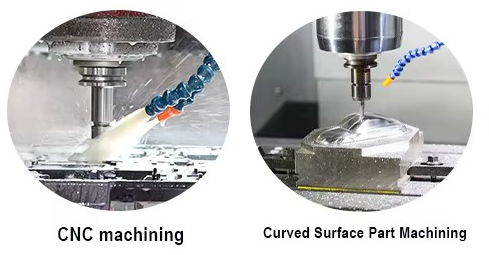
Once set up, the operator starts the CNC program. The machine then follows the G-code instructions automatically: The spindle rotates the cutting tool at high speeds (depending on the material and tool type).The machine’s axes (typically X, Y, Z for 3-axis machining; up to 5 axes for complex parts) move the tool or workpiece to the precise positions specified in the program.The cutting tool removes excess material from the workpiece, shaping it into the desired form.Coolant is often used to reduce heat (which can damage the tool or workpiece) and remove metal chips.
Step 5: Inspect the Finished Part
After machining, the finished part is inspected using precision tools (e.g., calipers, micrometers, CMMs—Coordinate Measuring Machines) to ensure it meets the CAD model’s specifications. If adjustments are needed, the CNC program or machine setup is modified, and the process is repeated.
Key Focus of CNC Machining (Critical Elements)
To achieve high-quality results, CNC machining focuses on three core elements—these are the foundation of its precision and efficiency:
1. Precision & Accuracy
The primary focus of CNC machining is microscopic precision. CNC machines can achieve tolerances as tight as ±0.001mm (0.00004 inches), far beyond what manual machining can accomplish. This is critical for industries like aerospace and medical, where even small deviations can cause part failure.
2. Repeatability
CNC machines can produce hundreds or thousands of identical parts with the same precision—every time. This repeatability eliminates human error and ensures consistency, making it ideal for high-volume production.
3. Tool Path Optimization
The CNC program’s tool path (the route the cutting tool takes) is optimized to minimize machining time, reduce tool wear, and improve surface finish. Efficient tool paths save time and costs while extending the life of cutting tools.
The Top Benefits of CNC Machining
CNC machining offers numerous advantages over manual machining and other manufacturing processes, making it the preferred choice for most modern industries. Here are the key benefits:
1. Unmatched Precision & Consistency
As mentioned, CNC machining delivers high precision and repeatability, ensuring every part meets exact specifications. This reduces waste and rework, saving time and money.
2. Increased Efficiency & Productivity
CNC machines can operate 24/7 with minimal human supervision (unlike manual machining, which requires constant operator input). This increases production output and reduces lead times—critical for meeting tight deadlines.
3. Ability to Produce Complex Parts
CNC machines (especially 5-axis models) can create complex, intricate parts with curved surfaces, holes, and contours that would be impossible or extremely difficult to produce manually. This opens up new design possibilities for engineers.
4. Reduced Human Error
By automating the machining process, CNC machining eliminates human error (e.g., miscalculations, hand tremors) that often occurs with manual operation. This improves part quality and reduces waste.
5. Cost-Effective for High-Volume Production
While CNC machines have a higher upfront cost, they become cost-effective for high-volume production. The automation reduces labor costs, and the precision reduces material waste—lowering the total cost per part.
6. Versatility
CNC machines can work with a wide range of materials, including metals (steel, aluminum, copper), plastics, wood, and composites. They can also switch between different parts quickly by updating the CNC program—making them ideal for small-batch or custom production.
Expert Insights: CNC Machining Best Practices
To provide practical guidance, we consulted Jennifer Lopez, a CNC machining specialist with 15+ years of experience in aerospace and medical manufacturing. Her insights help businesses and operators get the most out of CNC machining:
“The biggest mistake I see is underestimating the importance of CAD/CAM software and G-code optimization. Many operators focus on the machine itself, but the quality of the design and program directly impacts the final part. For CNC machining to work effectively, the CAD model must be precise, and the tool path must be optimized to reduce cycle time and tool wear. Additionally, regular machine maintenance is critical—even the most advanced CNC machine will fail to deliver precision if it’s not calibrated properly. Another key point: don’t overlook operator training. A skilled operator can troubleshoot issues, optimize programs, and ensure the machine runs at peak efficiency. CNC machining is a combination of technology and skill—you need both to succeed.”
Jennifer adds: “For small businesses, 3-axis CNC machines are often sufficient for most parts, while 5-axis machines are worth the investment for complex, high-precision components. The key is to match the machine to your specific needs—don’t overspend on features you won’t use.”
FAQs: Common Questions About CNC Machining
Q1: What does CNC stand for, and what is CNC machining in simple terms?
A: CNC stands for Computer Numerical Control. In simple terms, CNC machining is a process where a computer controls the movement of cutting tools to shape raw materials into precise parts—automating what was once done manually.
Q2: How does CNC machining differ from manual machining?
A: Manual machining relies on a human operator to control the tool and workpiece, which is prone to error and less consistent. CNC machining uses computer programs to automate the process, delivering higher precision, repeatability, and efficiency—especially for high-volume or complex parts.
Q3: What materials can be used in CNC machining?
A: CNC machining works with a wide range of materials, including metals (steel, aluminum, brass, titanium), plastics (ABS, PVC, nylon), wood, composites, and even some ceramics. The choice of material depends on the part’s application and required properties.
Q4: How long does it take to program a CNC machine?
A: Programming time varies based on the part’s complexity. Simple parts (e.g., a flat plate with a hole) can be programmed in 30 minutes to an hour. Complex parts (e.g., 5-axis aerospace components) may take several hours or even days to program—though once programmed, the machine can produce the part repeatedly with no additional programming.
Q5: Is CNC machining expensive?
A: CNC machines have a higher upfront cost (ranging from $10,000 for small benchtop models to $100,000+ for industrial machines). However, they are cost-effective for high-volume production, as they reduce labor costs, waste, and rework. For small-batch or custom production, many businesses use CNC machining services to avoid the upfront cost of buying a machine.
Q6: What is G-code, and why is it important for CNC machining?
A: G-code is the standard programming language used to control CNC machines. It translates the CAD model into specific instructions (movement, speed, tool selection) that the machine can understand. Without G-code, the CNC machine cannot execute the machining process—making it the backbone of CNC operation.
Conclusion: The Value of CNC Machining in Modern Manufacturing
CNC machining is more than just a manufacturing process—it’s a technology that has transformed industries by delivering precision, efficiency, and versatility. By understanding what CNC machining is and how it works (from CAD design to G-code execution), you can leverage its benefits to produce high-quality parts, reduce costs, and stay competitive in today’s fast-paced manufacturing landscape.
Whether you’re a large-scale manufacturer or a small business, CNC machining offers a solution for producing complex, consistent parts—all while saving time and resources. As expert Jennifer Lopez noted, the key to success is combining quality programming, machine maintenance, and operator skill to unlock the full potential of CNC machining.
Cnc machining what is it? A Complete Guide for Beginners & Professionals
What is cnc manufacturing? A Comprehensive Guide for Beginners & Professionals
Related Article
Custom CNC aluminum parts refer to non-standard, tailor-made aluminum components processed via professional CNC machining technology, customized according to clients’ unique drawings, size requirements, tolerance standards and application scenarios.
Custom cnc aluminum | How to customize aluminum CNC machined parts | Complete Guide
5-axis CNC machining is a high-end subtractive manufacturing process evolved from conventional 3-axis CNC milling.
5 axis cnc machining | What parts suit 5-axis CNC machining?Complete Guide With ADC12 Aluminum part